
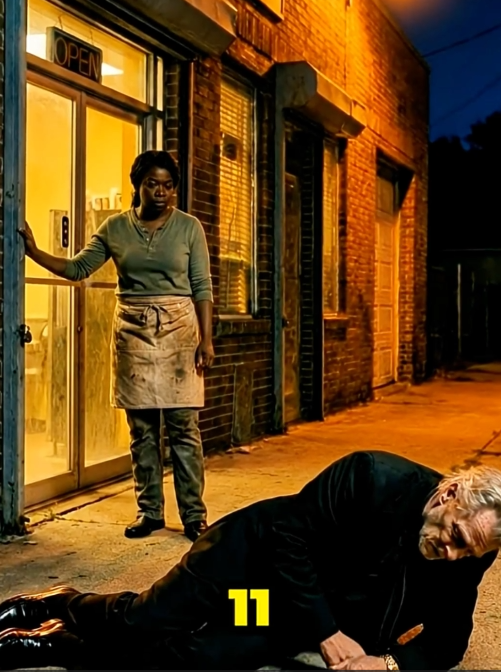
Denise Carter had only eleven dollars left in her bank account when her life changed outside her small restaurant.
Her rent was already three days late, and every bill waiting at home felt impossible to overcome.
That evening, she saw an elderly man collapse near the restaurant entrance wearing expensive Italian loafers.
Those shoes alone cost more than Denise spent on groceries in an entire month.
Everything inside her told her to keep walking and focus on surviving another difficult day.
But then she heard his breathing. A desperate, painful wheeze that sounded frighteningly familiar.
Years earlier, Denise had heard that same sound inside a hospital room when her mother stopped breathing.
She turned around immediately and rushed toward the stranger lying helplessly on the sidewalk.
“Sir, can you hear me?” Denise asked while helping him sit up and guiding him inside.
She placed him at the counter and ignored every reason telling her she could not afford this kindness.
Denise entered the kitchen and prepared a full meal using ingredients her restaurant could barely spare.
She served him smothered chicken, collard greens, and cornbread, the same comfort food her mother used to make.
Her coworker watched in disbelief. “Denise, we can barely pay our own bills. Why give away an entire meal?”
Denise simply replied, “Because someone hungry shouldn’t have to prove they deserve food.”
The stranger ate slowly, closing his eyes after every bite as memories seemed to return with each flavor.
“This tastes like a place someone I loved used to cook,” he whispered quietly.
When he finished, he reached for his wallet, but Denise immediately stopped him.
“My mama taught me to feed hungry people, not sell kindness to them,” she said.
The man stared at her for a long moment before quietly leaving the restaurant.
Outside, a black Escalade waited near the curb, and a driver opened the back door for him.
Denise watched from the window, unaware that the stranger was far more important than she imagined.
The next morning, she discovered a thick business card hidden beneath the restaurant salt shaker.
The card read Carlton Hughes, chairman of Hughes Hospitality Group, one of the largest restaurant companies in the country.
On the back, someone had written one sentence: “The best meal I’ve had in thirty years.”
Denise smiled briefly, but something about the name felt strangely familiar.
She returned home and searched through old belongings hidden beneath her bed for years.
Inside was a letter from Crestline Properties, a company she had never forgotten.
Crestline had purchased her mother’s building years earlier and demolished the family restaurant that once stood there.
Her mother, Emmaline, fought desperately against the eviction and demolition plans.
She stood outside the building holding a protest sign, begging them to preserve the place she created.
Nobody listened. The building was destroyed, and a luxury hotel eventually replaced it.
Six months later, Denise lost her mother, carrying the pain of losing both a family home and a beloved restaurant.
Now she held two documents with the same company name written across both pages.
One document represented everything taken from her family. The other belonged to the man who had eaten her mother’s recipes.
Denise sat in darkness, wondering whether Carlton Hughes knew what his company had done.
The next morning, Carlton returned to the restaurant, but this time he arrived without security or luxury vehicles.
“I owe you an explanation,” he said quietly as Denise stared at him.
She placed the old demolition notice on the table. “Your company destroyed my mother’s life.”
Carlton looked at the paper and immediately recognized the signature at the bottom.
His expression changed as he realized Denise was the daughter of the woman he had failed years earlier.
“I didn’t know,” Carlton whispered. Denise answered, “That seems to be what everyone says after the damage is done.”
Carlton opened old company files and discovered decisions made by executives who hid crucial information from him.
The demolition had been rushed, and Denise’s mother had been unfairly forced away through dishonest practices.
Carlton publicly admitted the company’s mistake and rebuilt Emmaline’s Kitchen as a tribute to Denise’s mother.
Years later, Denise managed the restaurant again, not because she inherited wealth, but because someone finally corrected an injustice.
The same kindness that saved a stranger’s life eventually restored the home her family thought was lost forever.
And Denise learned that one simple meal could uncover a truth buried for decades.