The quiet neighborhood had already settled for the evening when a man carrying grocery bags turned onto the sidewalk leading toward his home.
Streetlights flickered softly above him while neighbors relaxed on nearby porches, expecting another peaceful night without unusual interruptions or loud commotion.
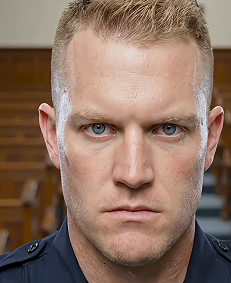
A police cruiser suddenly stopped beside the curb. Officer Carl Hadley stepped out with one hand already resting on his holstered weapon.
"Hands on the wall. Right now," Hadley shouted. "You people are always wandering where you do not belong."
The man remained calm despite the accusation. "Officer, I live here. Please allow me a moment to explain everything."
Hadley refused to listen. "Keep your mouth shut. I do not care where you claim to live. Turn around immediately."
Without warning, Hadley shoved the man face first against the rough brick wall with enough force to scatter every grocery bag.
Glass exploded across the sidewalk as a bottle shattered beneath his feet. Nearby neighbors watched silently, afraid to become involved.
The man never resisted. He quietly whispered, "Please be careful with my jacket, Officer. There are important items inside."
Hadley mocked him openly. "You do not give me orders. Out here you are nothing. Do you understand me?"
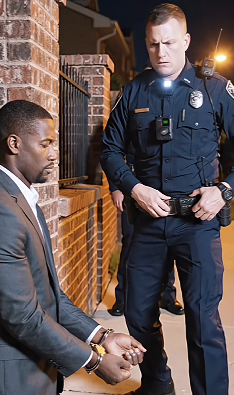
He ripped open the jacket, searched every pocket aggressively, and forced handcuffs around the man's wrists without asking another question.
A worn leather wallet slipped onto the pavement, opened beneath a streetlight, and revealed something that caught another officer's immediate attention.
The second officer slowly picked it up, stared inside, and suddenly froze. "Hadley, stop. Right now."
"What is your problem?" Hadley demanded. His partner answered by silently holding the open wallet directly before his astonished eyes.
Inside rested a gold badge beside an identification card displaying three unmistakable letters printed in bold blue. FBI.
The handcuffed man finally spoke. "Special Agent Wesley Turner, Civil Rights Division. I believe we should continue this conversation differently."
Silence swallowed the street. Even the neighbors who had watched quietly realized they had witnessed something far more serious than an ordinary arrest.
Within minutes supervisors arrived, removed Wesley's handcuffs, and ordered Officer Hadley to surrender both his badge and service weapon.
One commander apologized immediately. Wesley simply nodded without anger, quietly collecting his groceries scattered across the broken sidewalk.
Back inside his home, Wesley carefully documented every insult, every shove, every unnecessary action, and every exact timestamp from memory.
His assignment had never been secret from the Bureau. He had lived there undercover for three months investigating repeated allegations against the department.
The purpose was simple. Determine whether racial profiling and excessive force were isolated mistakes or an established pattern requiring federal intervention.
The following day Internal Affairs compared Hadley's written report with body camera footage recovered from every responding officer at the scene.
The recordings exposed false statements, omitted actions, and language completely absent from Hadley's official account, destroying his credibility within minutes.
Investigators soon uncovered similar complaints involving several unrelated citizens whose reports had previously been dismissed without meaningful review or accountability.
Hadley was terminated, criminal charges followed, and multiple officers faced disciplinary action as federal oversight expanded throughout the department.
When reporters later asked why he never revealed his badge sooner, Wesley answered quietly, "Respect should never depend on the badge inside someone's pocket."
His investigation transformed an entire police department, reminding the nation that justice begins the moment authority meets ordinary people, not after identities are revealed.